

Overview
Integrate Google’s new Assistant spatial framework into the automotive ecosystem, establishing a unified design system and cohesive interaction patterns for Google Assistant across diverse OEM display configurations.

Challenges and Opportunities
Spatial & Layout Integration: Integrating Assistant into a newly defined "negative space" layer that sits outside main content and system notifications, requiring main content and notifications to smoothly reflow or crop upon activation.
Multi-OEM Flexibility: Designing adaptable UI patterns (such as flexible voice plates and color-theming systems) that seamlessly conform to Android standards as well as varying OEM design systems and screen configurations.
Multimodal Interaction: Harmonizing voice invocation with touch interaction patterns across different driving contexts and task complexities.
Multi-OEM Flexibility: Designing adaptable UI patterns (such as flexible voice plates and color-theming systems) that seamlessly conform to Android standards as well as varying OEM design systems and screen configurations.
Multimodal Interaction: Harmonizing voice invocation with touch interaction patterns across different driving contexts and task complexities.
Guiding Principles
Safety & Ergonomics: Strict adherence to automotive safety guidelines and UX research by prioritizing map and active navigation visibility during Assistant interactions.
Design System Consistency: Leveraging existing Android Auto patterns and frameworks while preserving the core Google Assistant brand identity across custom OEM environments.
Testing & Prototyping: High-fidelity, fully interactive in-car prototyping incorporating both voice and touch inputs to continuously test, validate, or disprove framework iterations.
Design System Consistency: Leveraging existing Android Auto patterns and frameworks while preserving the core Google Assistant brand identity across custom OEM environments.
Testing & Prototyping: High-fidelity, fully interactive in-car prototyping incorporating both voice and touch inputs to continuously test, validate, or disprove framework iterations.
Target Audience
Drivers and Passengers: Requires hands-free, low-glance multimodal UI (voice + quick-action widgets) that minimizes cognitive load, prevents visual distraction, and prioritizes road safety.
Android Auto Designers: Internal design teams who need scalable UI frameworks, consistent interaction models, and rigid driving safety guardrails that function across varying display aspect ratios.
OEM Designers & Engineers: External partners who require a flexible design system and adaptable Assistant UI that allows them to preserve their distinct brand identity while leveraging Google’s voice intelligence.
Android Auto Designers: Internal design teams who need scalable UI frameworks, consistent interaction models, and rigid driving safety guardrails that function across varying display aspect ratios.
OEM Designers & Engineers: External partners who require a flexible design system and adaptable Assistant UI that allows them to preserve their distinct brand identity while leveraging Google’s voice intelligence.
Key Concept and Framework
A flexible, tiered approach for invocation, response, and fulfillment mapped strategically to designated vehicle display zones (side panel and bottom rail):

Soft Invoke: For minimal, non-disruptive requests.
Full Invoke with Voice Plate: Accommodates simple UI needs with an adaptable voice plate supporting custom OEM and Android color theming.
Side Panel Fulfillment: Designed for moderate UI needs that require richer information without obscuring primary driving context.
Full Invoke with Voice Plate: Accommodates simple UI needs with an adaptable voice plate supporting custom OEM and Android color theming.
Side Panel Fulfillment: Designed for moderate UI needs that require richer information without obscuring primary driving context.
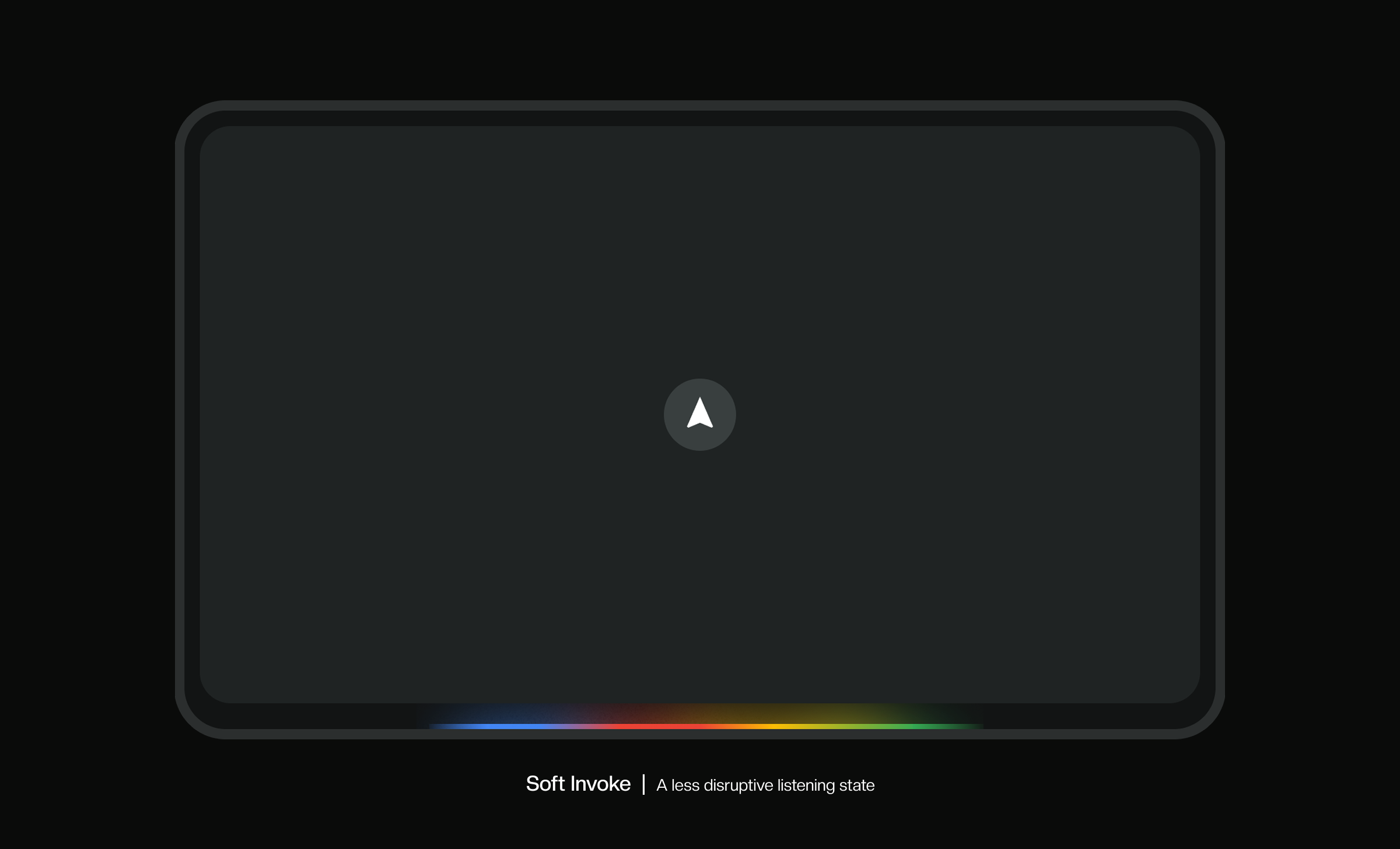

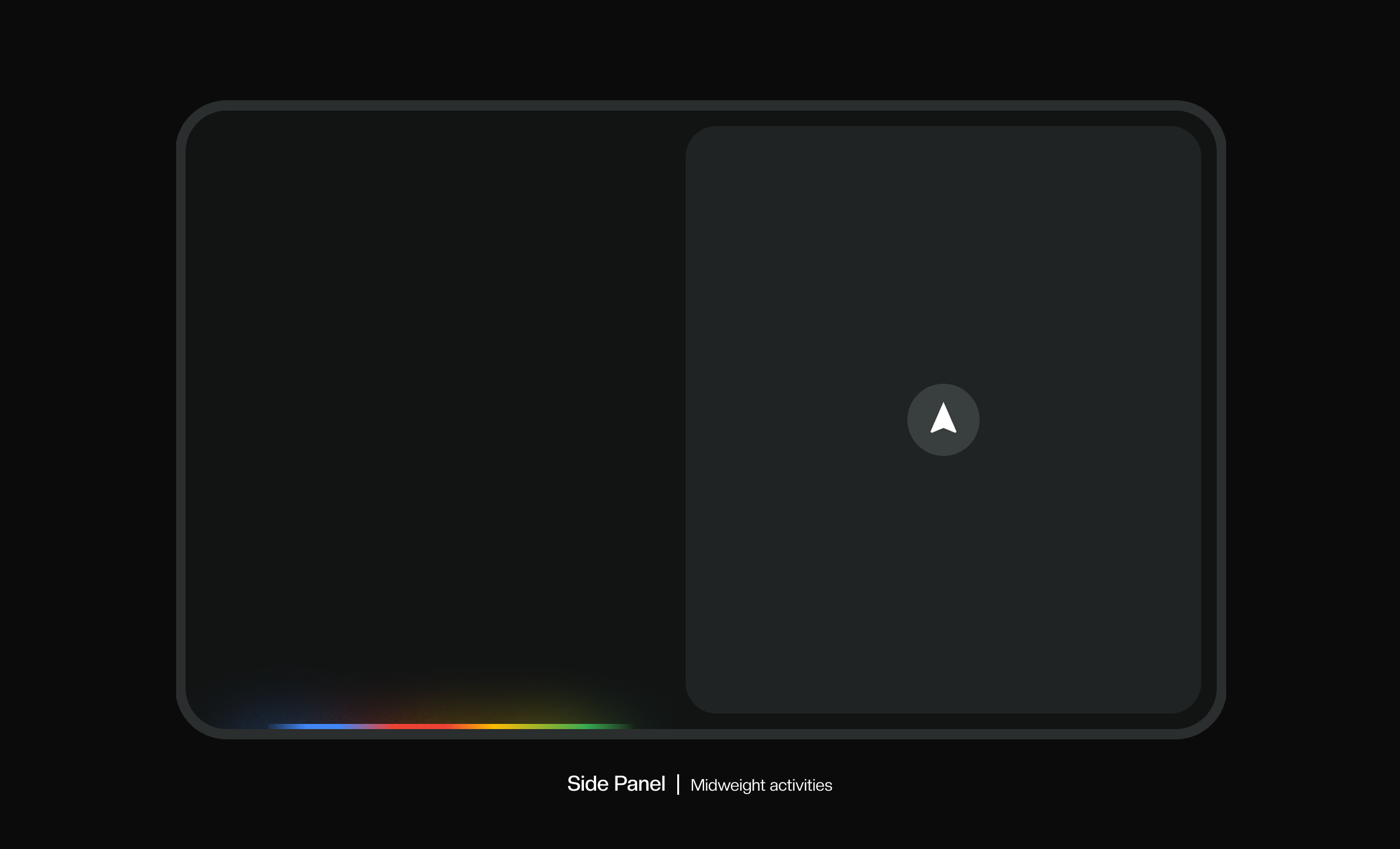
For the voice plate, we needed to accommodate various use cases and support a new flexible UI that could adapt to Android & OEM color theming. Here's a sampling of the work prepared

.jpg)
.jpg)
Prototyping and Validation
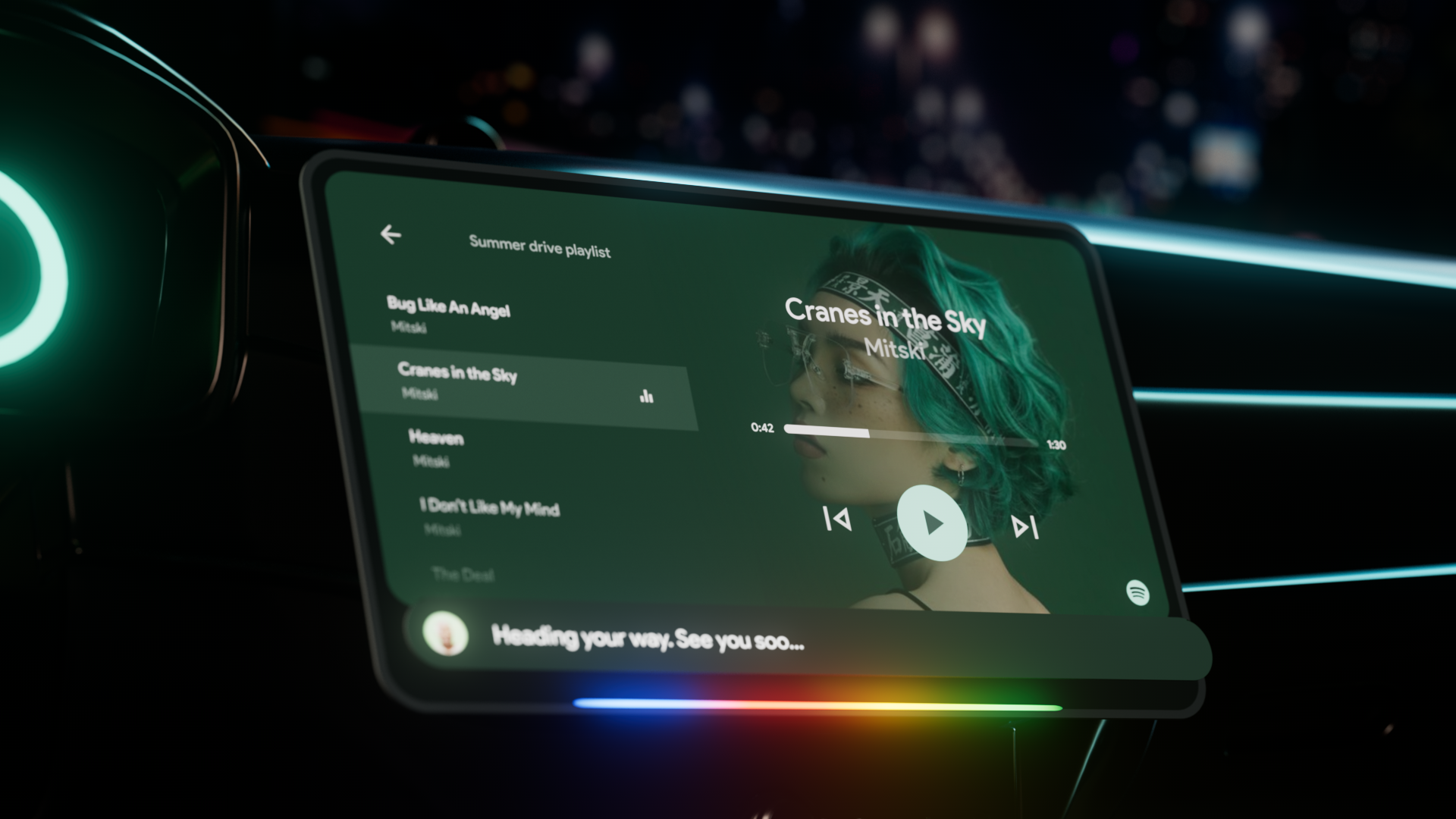
Interactive In-Car Prototypes: I built fully interactive, high-fidelity prototypes that enabled stakeholders and XFN partners to directly experience and test the end-to-end interface.
Multimodal Feedback Loops: Integrated simultaneous voice and touch interaction models into dynamic prototypes to evaluate real-time responsiveness, UI reflow, and touch ergonomics.
Rapid Framework Validation: Used interactive testing sessions to quickly validate core layout hypotheses, stress-test flexible OEM color-theming adaptations, and disprove ineffective spatial patterns early in the design cycle.
Multimodal Feedback Loops: Integrated simultaneous voice and touch interaction models into dynamic prototypes to evaluate real-time responsiveness, UI reflow, and touch ergonomics.
Rapid Framework Validation: Used interactive testing sessions to quickly validate core layout hypotheses, stress-test flexible OEM color-theming adaptations, and disprove ineffective spatial patterns early in the design cycle.


.gif)

%201.png)

© 2026 Nicework Studio LLC.